Dugong
The Dugong, also known as the "sea cow," is a large, gentle marine mammal native to the coastal waters of the Indo-Pacific. It is a close relative of the manatee and it is known for its unique, streamlined body and its flipper-like tail.
The Dugong is a herbivore that feeds on a variety of seagrasses. It is a vital part of its ecosystem, as its feeding habits help to maintain the health of seagrass meadows. The Dugong is an endangered species, with its numbers declining due to habitat loss and human conflict.
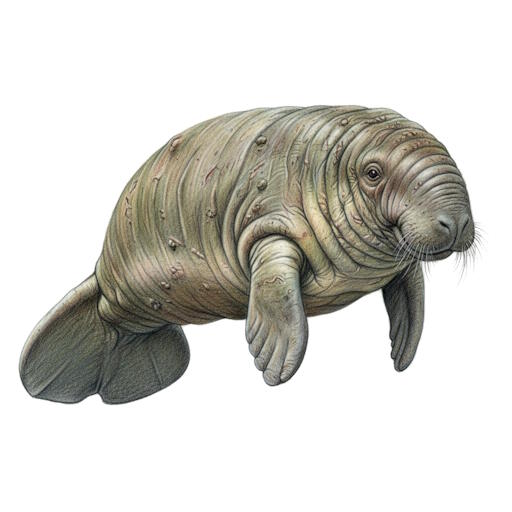
Dugong
Classification
Mammalia > Sirenia > Dugongidae > Dugong > D. dugon
Native To
Conservation Status
Average Height
8 - 10 feet
(2.4 - 3 m)
Average Weight
500 - 1,000 lbs
(227 - 454 kg)
Average Life Span
70 years
Gestation Period
365 - 400 days
Did You Know?
The Dugong is a marine mammal, often called a "sea cow," found in warm coastal waters from East Africa to Australia.
They are the only strictly herbivorous marine mammal, feeding mainly on seagrass.
Dugongs can hold their breath for up to 11 minutes and dive to depths of about 128 feet (39 meters) to graze on seagrass.
They can live for up to 70 years.
Female Dugongs typically give birth to a single calf after a gestation period of 13 to 14 months.
Dugongs communicate through a variety of sounds, including chirps, whistles, and barks.
They are gentle and shy creatures, often found alone or in small groups.
Unlike their close relatives, manatees, Dugongs have a fluked tail similar to a dolphin's, rather than a paddle-shaped one.
Their closest living relative on land is the elephant!
Photo Gallery
No images provided yet. Be the first to upload one!