Ibex
The Ibex is a genus of wild goats known for their impressive, long, curved horns and their remarkable ability to climb steep, rocky slopes. Found in mountain ranges across Europe, Asia, and Africa, these animals are perfectly adapted to life in rugged, high-altitude environments. Their hooves are designed with a soft inner pad and a sharp outer rim, providing exceptional grip on rocky surfaces.
The male's horns are particularly magnificent, growing longer and more curved with age, and they can be used for both defense and to establish dominance during mating season. Despite their powerful horns, the Ibex is a gentle herbivore, feeding on grasses, mosses, and leaves. They are a symbol of resilience and grace, navigating their difficult terrain with surprising ease.
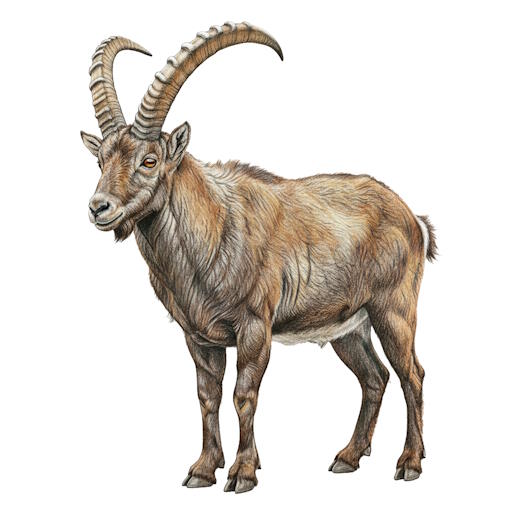
Ibex
Classification
Mammalia > Artiodactyla > Bovidae > Capra > C. ibex
Native To
Conservation Status
Average Height
2.5 - 3 feet
(0.8 - 0.9 m)
Average Weight
150 - 200 lbs
(68 - 90 kg)
Average Life Span
10 - 15 years
Gestation Period
160 - 170 days
Did You Know?
The Ibex is a wild goat species known for its impressive, long, curved horns, which can grow over a meter in length.
They are incredible climbers and are found in rugged, mountainous regions across Europe, Asia, and Africa.
Ibex have specialized hooves that provide excellent grip on steep and rocky terrain.
They are herbivores and primarily graze on grasses, herbs, and shrubs found in their high-altitude habitats.
During the winter months, Ibex often migrate to lower elevations to find food.
Both male and female Ibex have horns, but the males' horns are significantly larger and more prominent.
They live in herds, with males and females often living separately outside of the breeding season.
Ibex are well-adapted to cold environments, possessing a thick coat that provides insulation.
Photo Gallery
No images provided yet. Be the first to upload one!