Kinkajou
The Kinkajou (Potos flavus) is a tropical rainforest mammal native to Central and South America. It is a member of the raccoon family but is often mistaken for a primate or a ferret. It is also known as a "honey bear" because of its fondness for honey and nectar.
Kinkajous are arboreal and nocturnal, spending most of their lives high in the forest canopy. They have a long, prehensile tail that they use as a fifth limb for grasping branches and a long tongue for reaching into flowers and fruit. They are solitary animals that have a diet of fruit, nectar, and insects. They play an important role as a pollinator and seed disperser in their ecosystem.
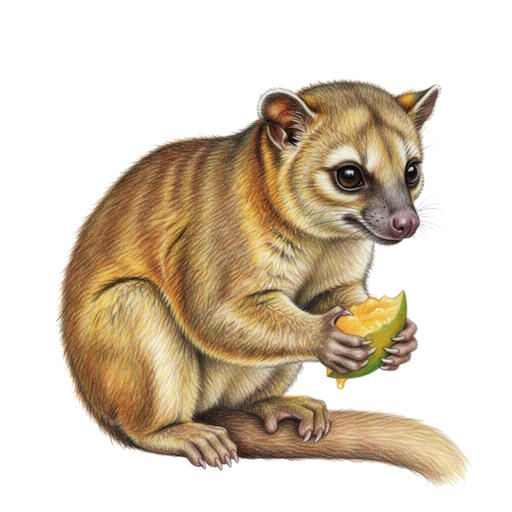
Kinkajou
Classification
Mammalia > Carnivora > Procyonidae > Potos > P. flavus
Native To
Conservation Status
Average Height
1.5 - 2 feet
(0.4 - 0.6 m)
Average Weight
3 - 7 lbs
(1.4 - 3.2 kg)
Average Life Span
20 - 25 years
Gestation Period
110 - 115 days
Did You Know?
The Kinkajou is a nocturnal mammal native to Central and South America.
They are sometimes called "honey bears" because they love to eat fruit and nectar, using their long, skinny tongue to reach inside flowers.
The Kinkajou has a prehensile tail, which means it can use its tail like an extra arm to grasp branches while climbing.
They are arboreal, spending most of their lives in trees.
Unlike most mammals, the Kinkajou has backward-facing feet that can rotate 180 degrees, allowing them to climb down trees headfirst.
They are part of the Procyonidae family, which also includes raccoons and coatis.
Photo Gallery
No images provided yet. Be the first to upload one!