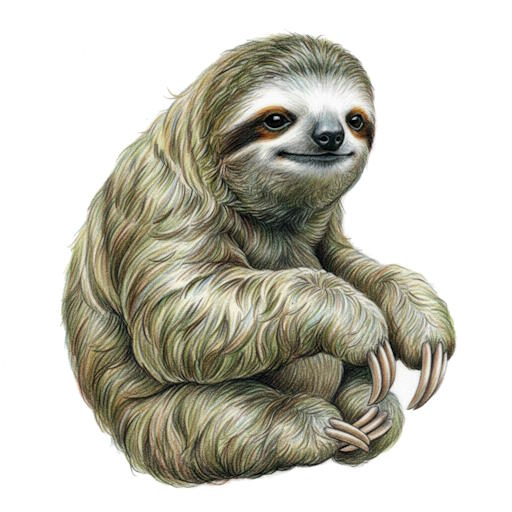
Animal Family: Bradypodidae
About the Bradypodidae Family
The parent order is Pilosa.
Delve into the uniquely slow and arboreal world of the Bradypodidae family, commonly known as three-toed sloths. These fascinating mammals are renowned for their deliberate movements, specialized diets, and a lifestyle intimately tied to the rainforest canopy, making them one of the most distinctive groups in the animal kingdom.
What truly sets Bradypodidae apart is their extreme specialization for an arboreal, folivorous (leaf-eating) existence, which has led to a suite of highly unusual adaptations. Their incredibly slow metabolism and low body temperature allow them to subsist on a low-energy diet of leaves. Unlike most mammals, their fur grows in the opposite direction, from belly to back, enabling rainwater to run off easily while they hang upside down. This unique fur also provides a microhabitat for algae, which can provide camouflage and even supplementary nutrition.
Animals within the Bradypodidae family share several key traits. They possess three clawed digits on each forelimb, which are expertly adapted for gripping branches. Their powerful, hook-like claws and long limbs are designed for hanging, not walking on the ground, where they are remarkably vulnerable. Another common characteristic is their unique cervical vertebrae, which allow them to rotate their heads up to 270 degrees, providing a wide field of vision without moving their bodies. Despite their apparent sluggishness, these sloths are surprisingly capable swimmers. Their singular evolutionary path and highly specialized adaptations make the Bradypodidae family a truly unique and compelling subject for zoological study.
Other Orders
There are many different orders based upon their class. To learn more about classification orders, click here.
Genera within Bradypodidae
Within the order of Bradypodidae, there are one or more genus of animals that share common characteristics and traits.
Each genus represents a more specific grouping within the order, highlighting the diversity and specialization of species that have adapted to various ecological niches. Below is a list of genera that fall under this order, showcasing the rich variety of life forms classified within this taxonomic category.
Bradypus
Animals in the family of Bradypodidae
Click on an image to learn more about one of the animals.