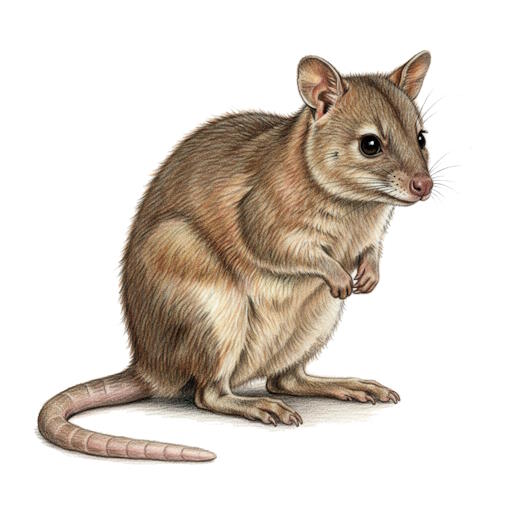
Animal Family: Hypsiprymnodontidae
About the Hypsiprymnodontidae Family
The parent order is Diprotodontia.
Delve into the intriguing world of the Hypsiprymnodontidae family, a small yet highly specialized group of marsupials native to Australia. Often referred to as rat-kangaroos or musky rat-kangaroos, these fascinating creatures represent an ancient lineage within the macropodiforms, offering a unique glimpse into the evolutionary history of kangaroos and wallabies.
What makes Hypsiprymnodontidae truly unique is their singular position as the most basal surviving family within the Macropodiformes. This means they retain several primitive traits that set them apart from their more derived relatives. Unlike larger kangaroos and wallabies, members of this family are typically small-bodied, resembling rodents more than classic macropods. A defining characteristic is their pentadactyl (five-toed) hind feet, which still possess a separate big toe—a feature lost in most other hopping macropods. This, combined with their plantigrade (flat-footed) posture when moving slowly, reflects a more generalized locomotion adapted for both quadrupedal scampering and occasional bipedal hops.
Animals within the Hypsiprymnodontidae family share several common traits that reflect their unique ecological niche. They are primarily solitary and nocturnal, spending their days foraging for a diverse diet of fruits, fungi, insects, and small invertebrates. Their sharp claws are well-suited for digging, a crucial adaptation for unearthing underground fungi and insects. Another shared feature is their relatively short, sparsely furred tail, which is not prehensile but can be used for balance. Their dental formula also distinguishes them, with upper canines often present, unlike in many other macropods. These combined characteristics highlight the evolutionary significance of the Hypsiprymnodontidae family as a living bridge to the early diversification of the iconic Australian marsupials.
Other Orders
There are many different orders based upon their class. To learn more about classification orders, click here.
Genera within Hypsiprymnodontidae
Within the order of Hypsiprymnodontidae, there are one or more genus of animals that share common characteristics and traits.
Each genus represents a more specific grouping within the order, highlighting the diversity and specialization of species that have adapted to various ecological niches. Below is a list of genera that fall under this order, showcasing the rich variety of life forms classified within this taxonomic category.
Hypsiprymnodon
Animals in the family of Hypsiprymnodontidae
Click on an image to learn more about one of the animals.