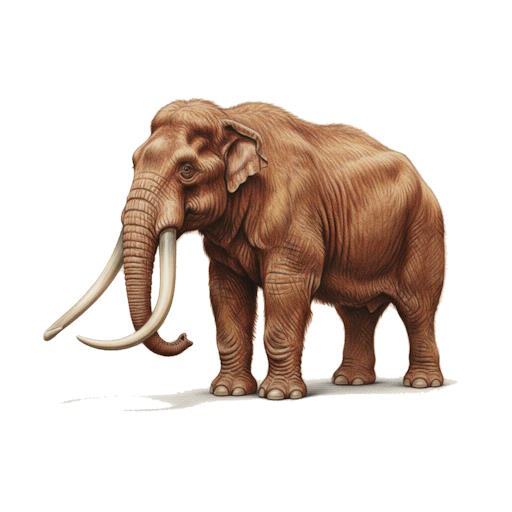
Animal Family: Mammutidae
About the Mammutidae Family
The parent order is Proboscidea.
Step back in time and discover the magnificent world of the Mammutidae family, an extinct group of proboscideans renowned for their impressive size and distinctive tusks. Often referred to as mastodons, these ancient giants roamed diverse landscapes across North America and Eurasia for millions of years, leaving behind a rich fossil record that tells a story of adaptation and resilience.
What truly made Mammutidae unique was their specialized dentition, which sets them apart from their elephantine relatives. Unlike the high-crowned, ridged molars of mammoths and modern elephants, mastodons possessed low-crowned, conical, and nipple-like cusps on their molars. This adaptation was perfectly suited for crushing and grinding coarser vegetation like leaves, twigs, and branches, indicating a browsing diet in forested and woodland environments. Their robust build, shorter legs, and broader bodies also distinguished them, allowing them to navigate denser terrains with ease.
Common traits among animals in the Mammutidae family included their enormous size, with some species reaching heights comparable to modern elephants, albeit with a more stocky build. They all shared the characteristic elongated tusks, which were typically straighter and less curved than those of mammoths, and were used for stripping bark, digging for roots, and possibly in intraspecific competition. These majestic herbivores played a crucial role in shaping ancient ecosystems, influencing plant distribution and serving as a food source for large predators. The study of Mammutidae provides invaluable insights into the evolutionary history of proboscideans and the dynamics of prehistoric megafauna.
Other Orders
There are many different orders based upon their class. To learn more about classification orders, click here.
Genera within Mammutidae
Within the order of Mammutidae, there are one or more genus of animals that share common characteristics and traits.
Each genus represents a more specific grouping within the order, highlighting the diversity and specialization of species that have adapted to various ecological niches. Below is a list of genera that fall under this order, showcasing the rich variety of life forms classified within this taxonomic category.
Mammut
Animals in the family of Mammutidae
Click on an image to learn more about one of the animals.