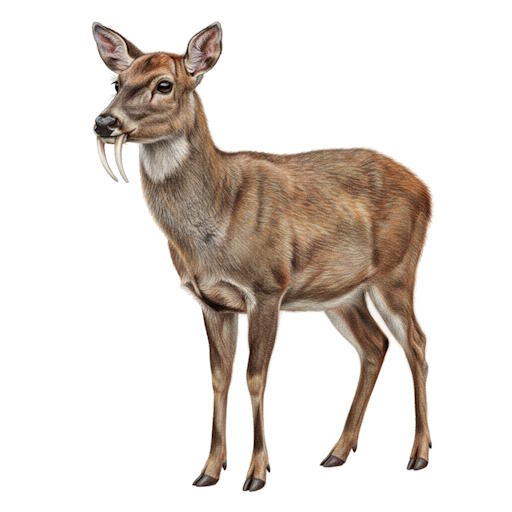
Animal Family: Moschidae
About the Moschidae Family
The parent order is Artiodactyla.
Delve into the intriguing world of the Moschidae family, commonly known as musk deer. These captivating ungulates represent a unique branch within the animal kingdom, distinct from true deer (Cervidae) despite their similar appearance. Their evolutionary path has equipped them with a fascinating array of adaptations that set them apart.
What makes Moschidae truly unique is the presence of a specialized musk gland in males, located near the tail. This gland produces a highly aromatic substance, musk, which has been historically prized in perfumery and traditional medicine. This characteristic is so defining that it gives the family its common name and is a primary driver of their ecological interactions and historical significance. Unlike many deer, musk deer also lack antlers, instead possessing elongated, saber-like canine teeth in males that are used in territorial displays and during the breeding season. Their relatively short legs and long hind legs give them a somewhat hunched appearance, well-suited for navigating the dense undergrowth of their mountainous habitats.
Animals within the Moschidae family share several common traits that reflect their adaptations to their often cold, high-altitude environments. They are generally small, shy, and solitary creatures, primarily nocturnal or crepuscular. Their diet consists mainly of lichens, mosses, grasses, and leaves, which they forage in dense forests and alpine scrublands. Their coloration, typically a mottled brown or gray, provides excellent camouflage against their natural backdrop. While superficially resembling small deer, their anatomical differences, particularly the musk gland and tusk-like canines, underscore their distinct classification and highlight their specialized adaptations for survival in challenging mountainous terrains across Asia.
Other Orders
There are many different orders based upon their class. To learn more about classification orders, click here.
Genera within Moschidae
Within the order of Moschidae, there are one or more genus of animals that share common characteristics and traits.
Each genus represents a more specific grouping within the order, highlighting the diversity and specialization of species that have adapted to various ecological niches. Below is a list of genera that fall under this order, showcasing the rich variety of life forms classified within this taxonomic category.
Moschus
Animals in the family of Moschidae
Click on an image to learn more about one of the animals.