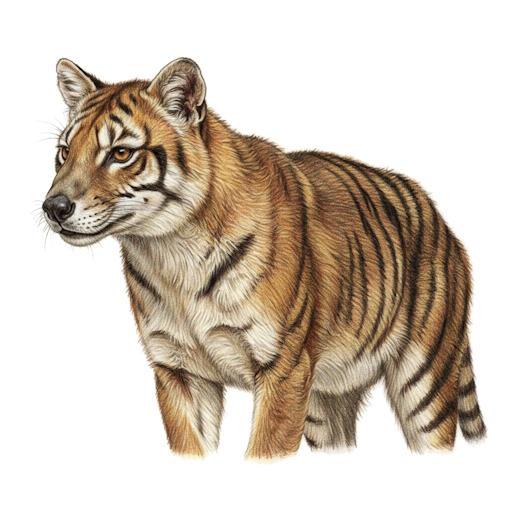
Animal Family: Thylacinidae
About the Thylacinidae Family
The parent order is Dasyuromorphia.
Step into the intriguing, yet somber, world of the Thylacinidae family, an extraordinary group of carnivorous marsupials. While most members of this family are extinct, it is most famously represented by the iconic, albeit likely extinct, Thylacine or Tasmanian Tiger. This family holds a unique place in evolutionary history, showcasing remarkable adaptations for predation within the marsupial lineage.
What made Thylacinidae truly unique was their striking convergence with placental canids, despite being marsupials. They evolved a dog-like appearance, complete with powerful jaws and teeth, perfectly suited for hunting. Common traits among members of this family included a carnivorous diet, a distinctive elongated skull, and a somewhat rigid, striped body. Their specialized dentition, including powerful carnassial teeth, allowed them to effectively process prey. Despite their superficial resemblance to canids, their pouch for carrying young firmly placed them within the marsupial infraclass, highlighting the fascinating paths of convergent evolution.
Other Orders
There are many different orders based upon their class. To learn more about classification orders, click here.
Genera within Thylacinidae
Within the order of Thylacinidae, there are one or more genus of animals that share common characteristics and traits.
Each genus represents a more specific grouping within the order, highlighting the diversity and specialization of species that have adapted to various ecological niches. Below is a list of genera that fall under this order, showcasing the rich variety of life forms classified within this taxonomic category.
Thylacinus
Animals in the family of Thylacinidae
Click on an image to learn more about one of the animals.