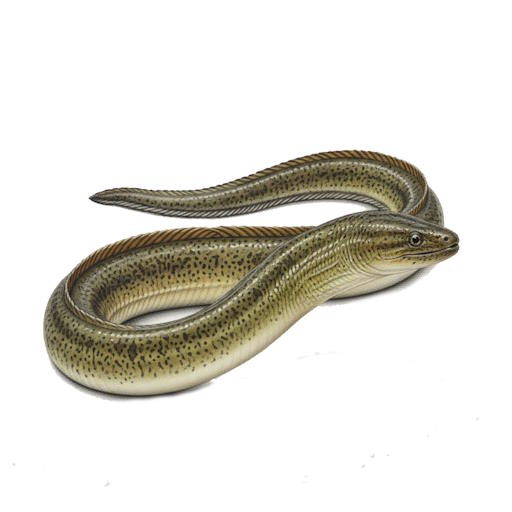
Animal Order: Anguilliformes
The parent class for the order of Anguilliformes is Actinopterygii.
The order Anguilliformes is a truly unique and fascinating group within the animal kingdom, commonly known as true eels. What fundamentally distinguishes anguilliforms from other fish and marine life is their remarkable serpentine body form, which has evolved to optimize their specialized ecological roles and behaviors across diverse aquatic environments.
Unlike most fish, eels possess an elongated, cylindrical, and often scaleless body, perfectly adapted for navigating through tight spaces, burrowing into substrates, and moving with incredible agility through water. This streamlined morphology, coupled with the absence or reduction of pelvic fins and often fused dorsal, caudal, and anal fins, allows for undulatory swimming, propelling them with fluid, snake-like movements that are both efficient and mesmerizing to observe.
A hallmark of the Anguilliformes is their unique life cycle, particularly the fascinating leptocephalus larval stage. These larvae are distinctly transparent, leaf-shaped, and flattened, drifting in ocean currents for extended periods—sometimes years—before undergoing a dramatic metamorphosis into the familiar elongated elver or glass eel form. This extended larval phase, often involving vast oceanic migrations, is a testament to their evolutionary success and sets them apart from most other vertebrate groups.
Furthermore, many species within this order exhibit extraordinary migratory patterns, such as the catadromous eels (e.g., Anguilla species) that are born in saltwater, migrate to freshwater to grow, and then return to the ocean to spawn. This remarkable biological journey, spanning thousands of kilometers, highlights their exceptional adaptability and navigational instincts.
Beyond their morphology and life cycle, eels display a wide array of adaptations to their varied habitats, which range from shallow coastal waters and coral reefs to deep-sea trenches and freshwater rivers. Many species are nocturnal, hiding in crevices or burrows during the day and emerging at night to hunt. Their acute sense of smell is crucial for locating prey, often small fish and invertebrates, in their complex environments.
In summary, the order Anguilliformes stands out due to its iconic serpentine body, its unique and prolonged leptocephalus larval stage, and its often complex migratory behaviors. These adaptations collectively underscore the evolutionary distinctiveness of true eels, making them a captivating subject for zoologists and a testament to the incredible diversity of aquatic life.
Other Orders
There are many different orders based upon their class. To learn more about classification orders, click here.
Families within Anguilliformes
Within the order of Anguilliformes, there are one or more families of animals that share common characteristics and traits.
Each family represents a more specific grouping within the order, highlighting the diversity and specialization of species that have adapted to various ecological niches. Below is a list of families that fall under this order, showcasing the rich variety of life forms classified within this taxonomic category.
Animals in the order of Anguilliformes
Click on an image to learn more about one of the animals.