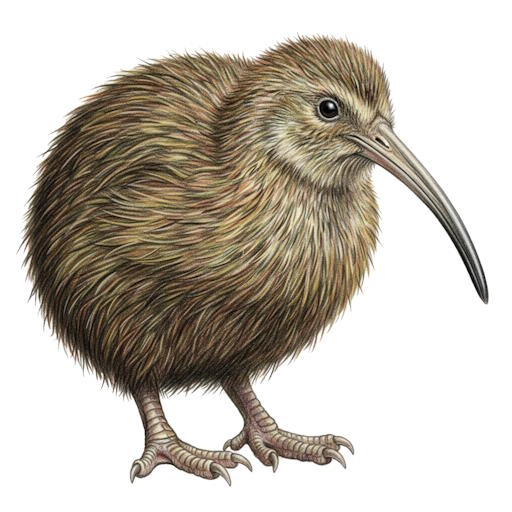
Animal Order: Apterygiformes
The parent class for the order of Apterygiformes is Aves (Avian).
The orderApterygiformes, comprising the iconic kiwis, holds a truly unique and fascinating position within the animal kingdom. Endemic to New Zealand, these extraordinary birds defy many typical avian characteristics, making them a captivating subject for study and a testament to evolutionary adaptation in isolated environments.
What sets kiwis apart begins with their highly unusual morphology. Unlike most birds, kiwis are flightless, possessing tiny, vestigial wings that are barely visible beneath their shaggy, hair-like feathers. This dense plumage, which lacks the barbules that give typical feathers their rigidity, offers excellent insulation in their damp forest habitats. Their bones, instead of being hollow and lightweight for flight, are heavy and marrow-filled, resembling those of mammals—a remarkable adaptation for a ground-dwelling existence.
Perhaps their most distinctive sensory adaptation is their elongated, sensitive bill, which has nostrils located at its very tip. This unique placement, coupled with an exceptional sense of smell, allows kiwis to forage for invertebrates buried deep underground, probing the soil with remarkable precision. This olfactory prowess is unparalleled among birds, making them primarily nocturnal hunters who rely more on scent and touch than sight or hearing to locate prey in the dark.
Furthermore, kiwis have a highly developed sense of touch at the tip of their bill, aided by specialized sensory pits and bristles, which helps them detect prey vibrations. They also possess large ear openings, indicating good hearing, another crucial adaptation for their nocturnal, subterranean foraging. Their low metabolic rate and relatively long lifespan for a bird of their size further contribute to their uniqueness.
Reproductively, kiwis lay an extraordinarily large egg in relation to their body size—one of the largest of any bird. This single, massive egg can constitute up to 20% of the female's body weight, a significant investment in a single offspring. Incubation is primarily handled by the male, another deviation from typical avian behavior. These combined characteristics—flightlessness, mammalian-like bones, highly developed olfaction and touch, and disproportionately large eggs—make the order Apterygiformes a truly singular and remarkable branch on the avian evolutionary tree, showcasing the incredible pathways that life can take when isolated from typical selective pressures.
Other Orders
There are many different orders based upon their class. To learn more about classification orders, click here.
Families within Apterygiformes
Within the order of Apterygiformes, there are one or more families of animals that share common characteristics and traits.
Each family represents a more specific grouping within the order, highlighting the diversity and specialization of species that have adapted to various ecological niches. Below is a list of families that fall under this order, showcasing the rich variety of life forms classified within this taxonomic category.
Animals in the order of Apterygiformes
Click on an image to learn more about one of the animals.