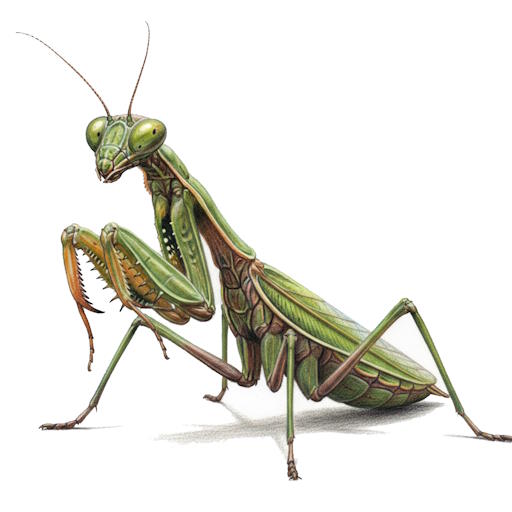
Animal Order: Mantodea
The parent class for the order of Mantodea is Insecta.
Few insect orders are as immediately recognizable and uniquely captivating as Mantodea, commonly known as praying mantises. What truly sets these remarkable predators apart in the animal kingdom is their highly specialized and iconic raptorial forelegs, evolved for an unparalleled ambush hunting strategy.
These powerful, serrated forelegs are designed for lightning-fast striking, allowing mantises to snatch and hold prey with astonishing precision and strength. This unique adaptation, coupled with their often cryptic camouflage and ability to remain perfectly still, makes them masters of predatory efficiency. Their triangular heads, capable of rotating 180 degrees, provide them with exceptional binocular vision, allowing for precise targeting of their next meal—whether it's an insect, spider, or even a small vertebrate.
Beyond their hunting prowess, mantises exhibit fascinating behaviors, including their well-known sexual cannibalism in some species, adding to their enigmatic allure. Their diverse array of forms, from stick-like mimics to flower-like camouflage, further highlights their evolutionary success in various ecosystems globally. The Mantodea order stands as a testament to specialized predatory evolution, embodying a unique combination of form and function that ensures their distinct place among the world's invertebrates.
Other Orders
There are many different orders based upon their class. To learn more about classification orders, click here.
Families within Mantodea
Within the order of Mantodea, there are one or more families of animals that share common characteristics and traits.
Each family represents a more specific grouping within the order, highlighting the diversity and specialization of species that have adapted to various ecological niches. Below is a list of families that fall under this order, showcasing the rich variety of life forms classified within this taxonomic category.
Animals in the order of Mantodea
Click on an image to learn more about one of the animals.