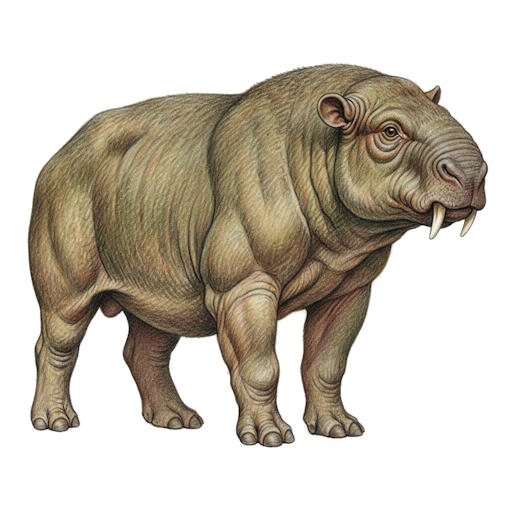
Animal Order: Notoungulata
The parent class for the order of Notoungulata is Mammalia.
The extinct order Notoungulata presents a compelling case study in unique evolutionary pathways within the animal kingdom. These fascinating mammals, primarily endemic to South America, represent an extraordinary adaptive radiation of ungulates that thrived from the Paleocene to the Pleistocene epochs. What truly sets Notoungulata apart is their remarkable convergence with various placental mammal groups from other continents, showcasing an independent development of features seen in horses, rhinos, rabbits, and even rodents, despite being only distantly related.
The uniqueness of Notoungulata lies in their highly diverse dental and skeletal adaptations. Their teeth, in particular, displayed an impressive array of forms, from high-crowned (hypsodont) teeth suitable for grazing in open grasslands, to low-crowned (brachydont) teeth for browsing in forested environments. This dental plasticity allowed them to exploit a wide range of ecological niches, contributing to their long evolutionary success. Furthermore, many notoungulates developed robust limb structures, with some exhibiting cursorial (running) adaptations similar to modern horses, while others were more stout-bodied, reminiscent of rhinos.
Beyond their diverse morphologies, Notoungulata's uniqueness is further highlighted by their insular evolution on the South American continent. Prior to the formation of the Isthmus of Panama, South America was largely isolated, allowing these native ungulates to diversify without significant competition from other mammalian groups. This isolation led to the evolution of forms such as the toxodonts, large, rhino-like browsers, and the typotheres and hegetotheres, smaller, rabbit- or rodent-like forms, all within a single order. Their eventual decline and extinction largely coincided with the Great American Biotic Interchange, when the land bridge formed and North American mammals migrated south, introducing new competitors and predators.
Studying Notoungulata offers invaluable insights into macroevolutionary patterns, demonstrating how geographical isolation can foster extraordinary adaptive radiation and the independent evolution of similar traits in different lineages. Their fossil record provides a rich tapestry of adaptations, making them a cornerstone for understanding the unique mammalian fauna of ancient South America and the intricate dance of evolutionary convergence.
Other Orders
There are many different orders based upon their class. To learn more about classification orders, click here.
Families within Notoungulata
Within the order of Notoungulata, there are one or more families of animals that share common characteristics and traits.
Each family represents a more specific grouping within the order, highlighting the diversity and specialization of species that have adapted to various ecological niches. Below is a list of families that fall under this order, showcasing the rich variety of life forms classified within this taxonomic category.
Animals in the order of Notoungulata
Click on an image to learn more about one of the animals.