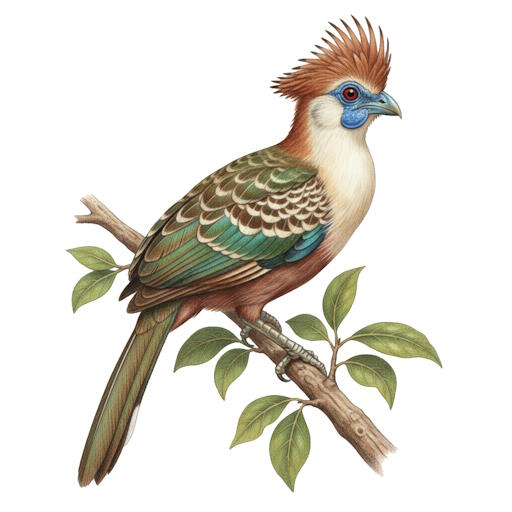
Animal Order: Opisthocomiformes
The parent class for the order of Opisthocomiformes is Aves (Avian).
The orderOpisthocomiformes, represented solely by the remarkable Hoatzin (Opisthocomus hoazin), stands as one of the most uniquely intriguing avian groups in the animal kingdom. Found in the Amazon and Orinoco basins of South America, the Hoatzin defies conventional bird characteristics, earning it a reputation as a "living fossil" due to its ancient and distinct lineage. Its uniqueness stems from a suite of evolutionary novelties, most notably its specialized digestive system, which is unparalleled among birds.
The Hoatzin is a folivore, meaning its diet consists primarily of leaves, buds, and flowers. To process this tough, low-nutrient vegetation, it has evolved a highly unusual digestive strategy: a massively enlarged crop and lower esophagus that function as a fermentation chamber, akin to the rumen of ruminant mammals. This foregut fermentation is powered by symbiotic bacteria, breaking down plant material and producing fatty acids for absorption. This adaptation gives the Hoatzin a strong, musky odor, leading to its local nickname "stinkbird," but more importantly, it allows the bird to exploit a dietary niche largely inaccessible to other avian species, making it a truly specialized herbivore.
Beyond its digestive peculiarities, the Hoatzin exhibits another striking, temporary adaptation: feathered claws on the wings of its chicks. These reptilian-like claws allow the young birds to clamber through vegetation with remarkable agility, particularly when escaping predators by dropping into the water and then climbing back into the safety of the trees. This feature, reminiscent of its evolutionary reptilian ancestry, is lost as the birds mature, replaced by typical adult wing structure. This fascinating developmental trait further underscores the Hoatzin's singular position in avian evolution.
Furthermore, the Hoatzin's skeletal structure is uniquely adapted to accommodate its enormous digestive system, with a reduced keel bone (the anchor point for flight muscles) making it a relatively weak flyer, often preferring to glide or make short, clumsy flights between branches. Its social behavior, often nesting in small, cooperative groups, also contributes to its distinct ecological profile. The combination of its fermentation-based digestion, clawed chicks, and specialized locomotion truly sets the Opisthocomiformes apart, offering a captivating glimpse into avian evolutionary pathways and making it a prime subject for zoological study and conservation efforts in its unique wetland habitats.
Other Orders
There are many different orders based upon their class. To learn more about classification orders, click here.
Families within Opisthocomiformes
Within the order of Opisthocomiformes, there are one or more families of animals that share common characteristics and traits.
Each family represents a more specific grouping within the order, highlighting the diversity and specialization of species that have adapted to various ecological niches. Below is a list of families that fall under this order, showcasing the rich variety of life forms classified within this taxonomic category.
Animals in the order of Opisthocomiformes
Click on an image to learn more about one of the animals.