Bandicoot
The Bandicoot is a small, ground-dwelling marsupial native to Australia and New Guinea. It is known for its long, pointed snout, which it uses to forage for insects, worms, and other invertebrates.
The Bandicoot is a master of excavation, capable of digging small, cone-shaped holes in the ground to find its food. It is a solitary and nocturnal animal that plays a vital role in its ecosystem, as its digging helps to aerate the soil and mix organic matter. The Bandicoot is a fascinating and beneficial animal that is a true marvel of nature.
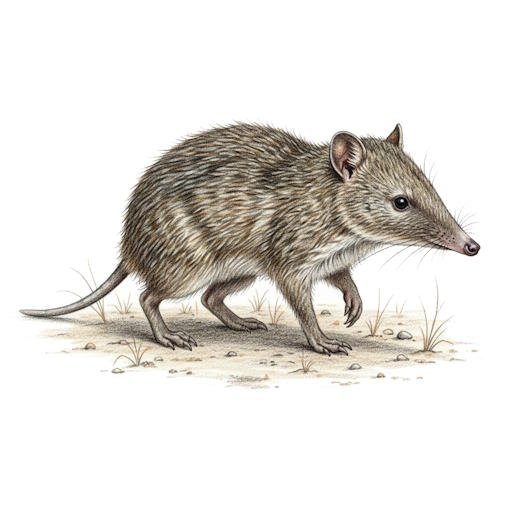
Bandicoot
Classification
Mammalia > Peramelemorphia > Peramelidae > Perameles > P. nasuta
Native To
Conservation Status
Average Height
1 - 1.5 feet
(0.3 - 0.5 m)
Average Weight
2 - 4 lbs
(0.9 - 1.8 kg)
Average Life Span
2 - 4 years
Gestation Period
12 - 14 days
Did You Know?
The Bandicoot is a small to medium-sized marsupial native to Australia and New Guinea.
They have a long, pointed snout and strong claws, which they use to dig for insects, worms, and roots.
Bandicoots are primarily nocturnal, meaning they are most active at night.
Female Bandicoots have a backward-opening pouch, which helps prevent dirt from entering while they are digging.
There are many different species of Bandicoots, ranging in size from that of a small mouse to a rabbit.
Some Bandicoot species are known for their ability to jump and hop with great speed.
Photo Gallery
No images provided yet. Be the first to upload one!