Great Hornbill
The Great Hornbill is a large and beautiful bird native to the forests of Southeast Asia. It is known for its large, yellow casque on its head and its beautiful, colorful plumage.
The Great Hornbill is a vital part of its ecosystem, as its fruit-eating habits help to disperse seeds.
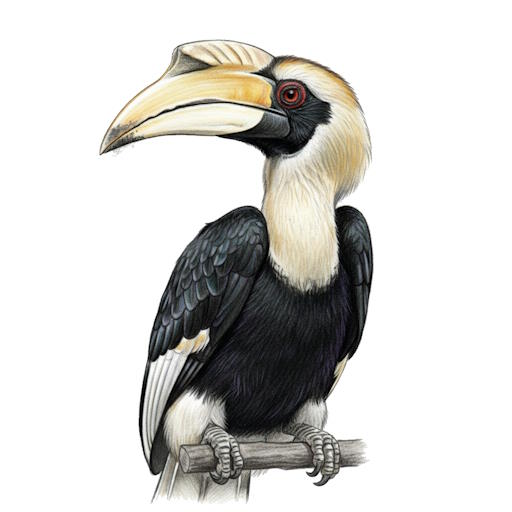
Great Hornbill
Classification
Aves > Bucerotiformes > Bucerotidae > Buceros > B. bicornis
Native To
Conservation Status
Average Height
3 - 4 feet
(0.9 - 1.2 m)
Average Weight
5 - 9 lbs
(2.3 - 4.1 kg)
Average Life Span
30 - 40 years
Gestation Period
40 days
Did You Know?
The Great Hornbill is one of the largest hornbill species, with a wingspan of up to 5 feet!
They are known for their prominent casque, a hollow structure on top of their large beaks, which acts as a resonator for their calls.
Great Hornbills have a unique nesting behavior where the female seals herself inside a tree cavity to lay eggs, relying on the male to bring her food through a narrow slit.
Their diet mainly consists of fruits, especially figs, but they also eat insects, small reptiles, and mammals.
They play a crucial role in seed dispersal in their forest habitats.
Great Hornbills are found in forests across India, Southeast Asia, and Indonesia.
They can live for over 50 years in captivity.
Photo Gallery
No images provided yet. Be the first to upload one!