Humpback Whale
The Humpback Whale (Megaptera novaeangliae) is a species of baleen whale found in oceans worldwide. They are famous for their massive size, with adults reaching up to 52 feet in length and weighing up to 40 tons. Humpbacks are known for their spectacular acrobatic displays, including breaching—launching their bodies out of the water—and tail slapping. They also undertake one of the longest migrations of any mammal, traveling thousands of miles between their cold-water feeding grounds and warm-water breeding grounds. But perhaps their most fascinating trait is their complex and haunting songs.
Male Humpbacks produce long, intricate vocalizations that can last for hours and travel for miles underwater. The purpose of these songs is not fully understood, but it is believed they are related to courtship rituals.
Humpback Whales feed on tiny crustaceans and small fish by a method called bubble-net feeding, a cooperative hunting technique unique to this species.
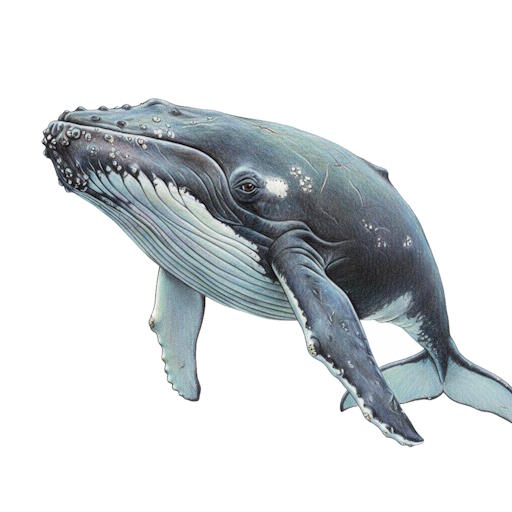
Humpback Whale
Classification
Mammalia > Cetacea > Balaenopteridae > Megaptera > M. novaeangliae
Native To
Conservation Status
Average Height
40 - 50 feet
(12 - 15 m)
Average Weight
55,000 - 66,000 lbs
(25,000 - 30,000 kg)
Average Life Span
40 - 50 years
Gestation Period
330 days
Did You Know?
The Humpback Whale is known for its haunting and complex songs, which can last for up to 20 minutes and be heard miles away.
They are famous for their acrobatic breaches, leaping almost entirely out of the water.
Humpback Whales have distinctive long pectoral fins, which can be up to one-third of their body length.
Each Humpback Whale has a unique pattern on the underside of its tail fluke, like a human fingerprint, which scientists use to identify them.
They feed by a method called bubble-net feeding, where a group of whales blows bubbles in a circle to create a "net" to trap fish.
Humpback Whales undertake one of the longest migrations of any mammal, traveling thousands of miles between feeding and breeding grounds.
Photo Gallery
No images provided yet. Be the first to upload one!