Kangaroo
The Kangaroo is an iconic marsupial native to Australia. It is known for its powerful hind legs, which it uses to propel itself in leaps and bounds, covering large distances with incredible speed. Kangaroos are the largest marsupials in the world. They are herbivores, grazing on grasses and shrubs. Perhaps their most fascinating feature is their method of reproduction.
The female Kangaroo has a pouch, or marsupium, where she raises her young, known as a joey. A joey is born in a very underdeveloped state and must crawl from the birth canal into the mother's pouch, where it will continue to develop and feed for several months.
Kangaroos are social animals, living in groups called mobs. They are a national symbol of Australia and an important part of its unique ecosystem.
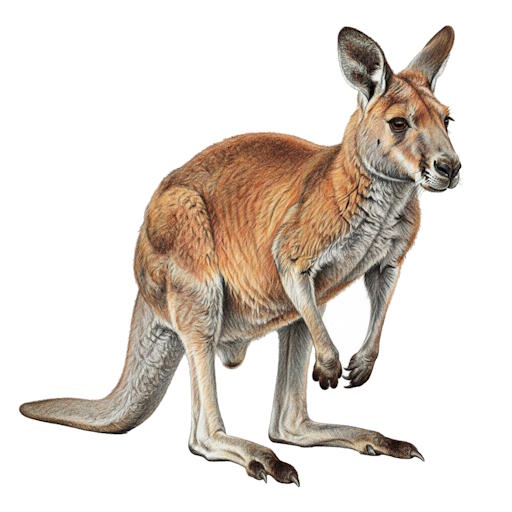
Kangaroo
Classification
Mammalia > Diprotodontia > Macropodidae > Macropus > M. rufus
Native To
Conservation Status
Average Height
3 - 6 feet
(0.9 - 1.8 m)
Average Weight
50 - 200 lbs
(23 - 90 kg)
Average Life Span
10 - 15 years
Gestation Period
33 days
Did You Know?
The Kangaroo is a marsupial native to Australia.
They are known for their powerful hind legs and large feet, which allow them to hop at high speeds.
A group of Kangaroos is called a mob, troop, or herd.
Female Kangaroos have a pouch where they carry and nurse their young, called joeys.
Kangaroos are herbivores, primarily eating grasses and plants.
They can live for up to 6 years in the wild and over 20 years in captivity.
There are four main species of Kangaroo: the Red Kangaroo, Antilopine Kangaroo, Eastern Grey Kangaroo, and Western Grey Kangaroo.
Photo Gallery
No images provided yet. Be the first to upload one!