Quoll
The Quoll Dasyurus is a genus of carnivorous marsupials native to mainland Australia, Tasmania, and New Guinea. There are several species of quoll, including the Eastern Quoll, Western Quoll, and Spotted-tailed Quoll, which is the largest.
Quolls are known for their spotted coats, pointed snouts, and sharp teeth, which they use to hunt their prey. They are solitary and nocturnal hunters, preying on a variety of animals, including insects, birds, lizards, and small mammals. They are also known to scavenge.
The largest species, the Spotted-tailed Quoll, is an agile climber and can hunt in trees as well as on the ground. Unfortunately, many quoll species are facing significant threats, including habitat loss, competition with introduced predators like cats and foxes, and poisoning from cane toads. As a result, several species are considered endangered or vulnerable. Conservation efforts are underway to protect the remaining populations and reintroduce them into safe habitats. The Quoll plays a vital role in its ecosystem as a top predator, and its survival is crucial for the health of its native environment.
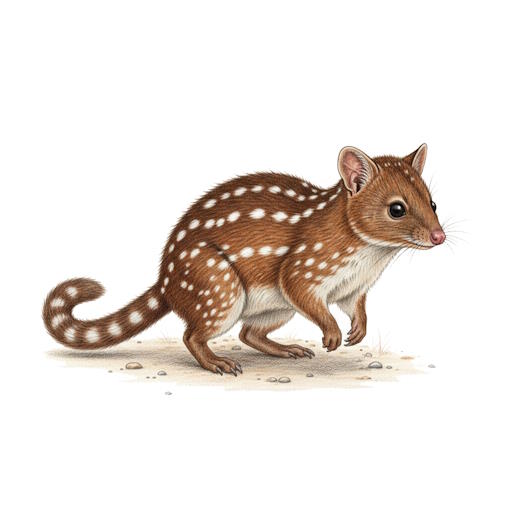
Quoll
Classification
Mammalia > Dasyuromorphia > Dasyuridae > Dasyurus > D. viverrinus
Native To
Conservation Status
Average Height
1.5 - 2 feet
(0.5 - 0.6 m)
Average Weight
2 - 4 lbs
(0.9 - 1.8 kg)
Average Life Span
3 - 5 years
Gestation Period
20 - 24 days
Did You Know?
The Quoll is a carnivorous marsupial native to Australia and New Guinea.
There are six species of Quoll, ranging in size from the small Northern Quoll to the much larger Spotted-tailed Quoll.
Quolls are nocturnal hunters, preying on insects, birds, lizards, and small mammals.
They have distinctive white spots on their fur, which helps them camouflage in dappled moonlight.
Sadly, Quoll populations have declined due to habitat loss, introduced predators, and poisoning.
Photo Gallery
No images provided yet. Be the first to upload one!