Red-legged Pademelon
The Red-legged Pademelon Thylogale stigmatica is a small marsupial native to the rainforests and wet sclerophyll forests of eastern Australia. It is a type of wallaby, but it is smaller and more compact than its larger relatives.
The Red-legged Pademelon is easily identified by the reddish-brown fur on its legs and the paler patch of fur on its belly. It is a solitary and nocturnal animal, spending its nights foraging for food. Its diet consists of fallen leaves, fruits, and grasses. Like other macropods, it moves by hopping on its powerful hind legs, and it has a short, thick tail that it uses for balance.
Red-legged Pademelons are often seen in dense undergrowth, where they can quickly disappear when they feel threatened. They play an important role in their ecosystem as herbivores, helping to disperse seeds and maintain the forest floor. While they are not currently considered endangered, they are vulnerable to habitat loss and predation by introduced species like dogs and foxes.
The Red-legged Pademelon is a shy and secretive creature, a true symbol of the rich and unique biodiversity of the Australian bush.
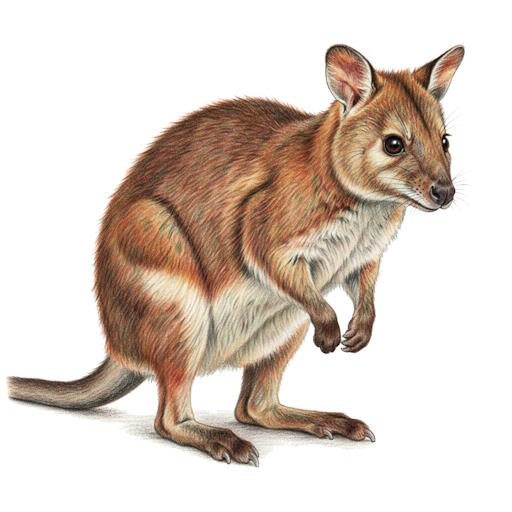
Red-legged Pademelon
Classification
Mammalia > Diprotodontia > Macropodidae > Thylogale > T. stigmatica
Native To
Conservation Status
Average Height
1.5 - 2 feet
(0.5 - 0.6 m)
Average Weight
10 - 15 lbs
(4.5 - 6.8 kg)
Average Life Span
6 - 8 years
Gestation Period
30 days
Did You Know?
The Red-legged Pademelon is a small marsupial found in the rainforests of northeastern Australia and New Guinea.
They are nocturnal and spend their days resting in dense vegetation.
Their diet consists mainly of fallen fruit, leaves, and grasses.
Red-legged Pademelons are named for the distinctive reddish-brown fur on their legs.
They are part of the kangaroo family, but unlike kangaroos, they have short, stout legs and a relatively short tail.
When startled, they can move quickly through the undergrowth, creating well-worn "pademelon runs."
Photo Gallery
No images provided yet. Be the first to upload one!