Red-necked Wallaby
The Red-necked Wallaby Notamacropus rufogriseus, also known as the Bennett's Wallaby, is a medium-sized macropod native to the coastal regions of eastern Australia and Tasmania. It is easily recognized by the reddish-brown fur on the back of its neck and shoulders.
Red-necked Wallabies are highly adaptable and can be found in a variety of habitats, including forests, woodlands, and grasslands. They are primarily nocturnal and crepuscular, meaning they are most active at dawn and dusk. Their diet consists of grasses, leaves, and other vegetation. Like other macropods, they move by hopping on their powerful hind legs and use their long, thick tails for balance. Females have a pouch where they raise their young, called "joeys".
The Red-necked Wallaby is a common and widespread species, and its populations are considered stable. In some areas, they have become quite tame and can be seen grazing in open fields and even suburban lawns.
The Red-necked Wallaby is a beloved and iconic part of the Australian landscape, a testament to the resilience of its kind.
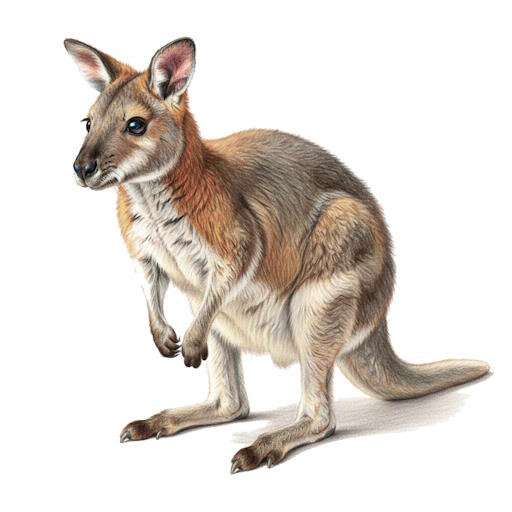
Red-necked Wallaby
Classification
Mammalia > Diprotodontia > Macropodidae > Notamacropus > N. rufogriseus
Native To
Conservation Status
Average Height
2.5 - 3 feet
(0.8 - 0.9 m)
Average Weight
30 - 40 lbs
(14 - 18 kg)
Average Life Span
9 - 15 years
Gestation Period
30 days
Did You Know?
The Red-necked Wallaby is native to eastern Australia and Tasmania.
They are marsupials, meaning the females carry their young in a pouch.
Red-necked Wallabies are primarily nocturnal, meaning they are most active at night.
They are herbivores and mainly eat grasses, leaves, and shrubs.
Their powerful hind legs allow them to hop at surprising speeds.
The "red-necked" part of their name comes from the reddish fur on their neck and shoulders.
They can live up to 9 years in the wild and longer in captivity.
Photo Gallery
No images provided yet. Be the first to upload one!