Rhinoceros Hornbill
The Rhinoceros Hornbill Buceros rhinoceros is a large, iconic bird native to the rainforests of Southeast Asia. It is one of the largest hornbills and is easily recognizable by its massive, curved, and orange-red "casque" on top of its beak, which resembles a rhinoceros horn. The purpose of the casque is not fully understood, but it is believed to be used in display and communication.
Rhinoceros Hornbills are monogamous and form a strong pair bond. During the nesting season, the female seals herself inside a tree cavity with mud, leaving only a small slit for the male to pass food through. She remains there for several months to lay her eggs and raise her chicks, while the male provides food for the entire family. This unique nesting behavior protects the female and her young from predators.
Rhinoceros Hornbills are important seed dispersers in their ecosystem. They are threatened by habitat loss and illegal hunting.
The Rhinoceros Hornbill is a magnificent and unique bird, a true symbol of the richness and diversity of the rainforest.
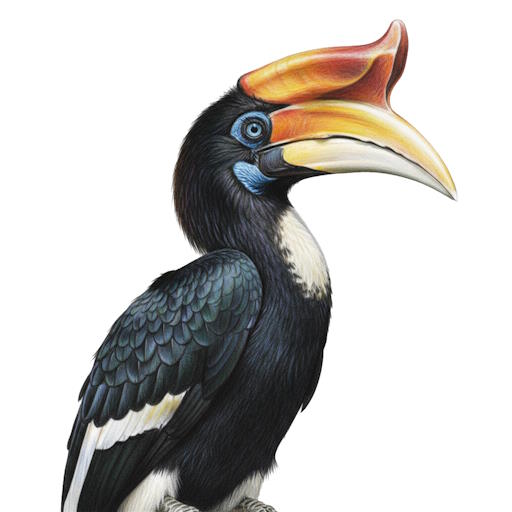
Rhinoceros Hornbill
Classification
Aves > Bucerotiformes > Bucerotidae > Buceros > B. rhinoceros
Native To
Conservation Status
Average Height
3 - 4 feet
(0.9 - 1.2 m)
Average Weight
5 - 7 lbs
(2.3 - 3.2 kg)
Average Life Span
35 years
Gestation Period
40 days
Did You Know?
The Rhinoceros Hornbill is one of the largest hornbill species, known for its distinctive, upward-curving casque on top of its beak, which resembles a rhinoceros horn.
These birds are found in tropical and subtropical rainforests in Southeast Asia, including Malaysia, Indonesia, and Thailand.
Rhinoceros Hornbills are monogamous and form strong pair bonds, often nesting in natural tree cavities.
During nesting, the female seals herself inside a tree hole using mud, droppings, and food, leaving only a small slit through which the male feeds her and the chicks.
Their diet primarily consists of fruits, especially figs, but they also eat insects and small vertebrates. They play an important role in seed dispersal in their ecosystem.
The casque of the Rhinoceros Hornbill is hollow and acts as a resonating chamber, amplifying their calls, which can be heard from a great distance.
They are known for their loud and distinctive calls, which often sound like "honk-honk-honk."
The Rhinoceros Hornbill is culturally significant in many indigenous communities in Southeast Asia, often appearing in folklore and traditional art.
Photo Gallery
No images provided yet. Be the first to upload one!