Wallaby
The Wallaby is a small to medium-sized macropod, a type of marsupial, native to Australia and the surrounding islands. The term "wallaby" is a broad category that includes a variety of species, all of which are smaller than a kangaroo.
Wallabies are known for their powerful hopping locomotion and their long, thick tails, which they use for balance. Females have a pouch where they raise their young, called "joeys".
Wallabies are herbivores, feeding on a wide variety of grasses, leaves, and other vegetation. They are highly adaptable and can be found in a variety of habitats, including forests, woodlands, and grasslands.
The Wallaby is a true icon of the Australian bush and a beloved part of the country's unique fauna.
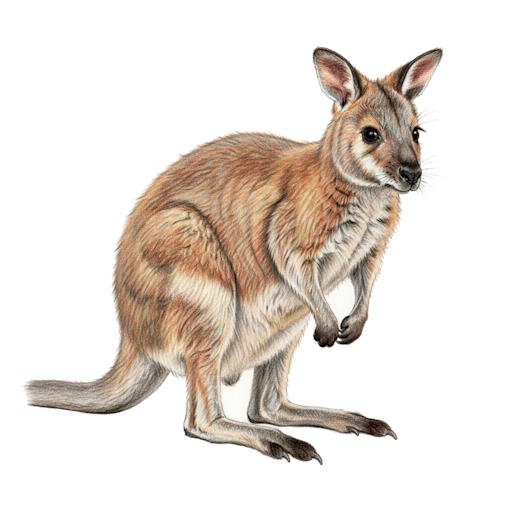
Wallaby
Classification
Mammalia > Diprotodontia > Macropodidae > Macropus > M. rufogriseus
Native To
Conservation Status
Average Height
2 - 3 feet
(0.6 - 0.9 m)
Average Weight
20 - 40 lbs
(9 - 18 kg)
Average Life Span
9 - 15 years
Gestation Period
30 days
Did You Know?
The Wallaby is a marsupial found in Australia and New Guinea, closely related to kangaroos but generally smaller.
Female Wallabies have a pouch where their young, called joeys, develop and stay safe.
There are many different species of Wallabies, varying in size, habitat, and appearance.
Wallabies are primarily herbivores, feeding on grasses, leaves, and other plant matter.
They can hop at considerable speeds and use their powerful hind legs and tail for balance.
Some Wallaby species are nocturnal, while others are active during the day or at dawn and dusk.
Photo Gallery
No images provided yet. Be the first to upload one!