American Mastodon
The American Mastodon was a massive, elephant-like creature that roamed North America during the Ice Age.
It was smaller than its cousin, the Woolly Mammoth, but it was still an impressive sight, with long, curved tusks that could reach over 15 feet. Unlike the mammoth, the mastodon was a browser that fed on trees and shrubs.
It had a shaggy, brown coat that protected it from the cold. The American Mastodon is believed to have become extinct around 10,000 years ago, likely due to a combination of climate change and hunting by early humans. It is a fascinating reminder of the incredible megafauna that once roamed our continent.
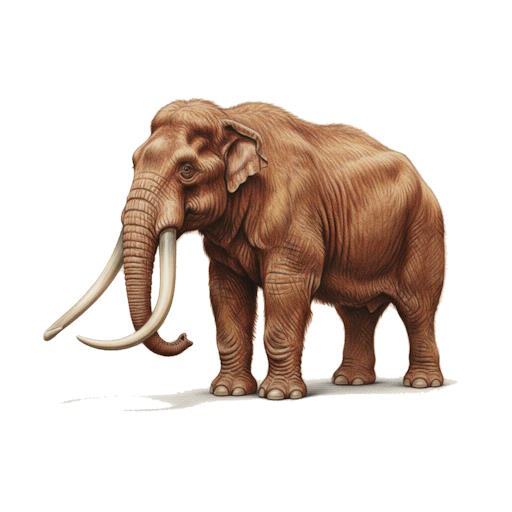
American Mastodon
Classification
Mammalia > Proboscidea > Mammutidae > Mammut > M. americanum
Native To
Conservation Status
Average Height
8 - 10 feet
(2.4 - 3 m)
Average Weight
12,000 - 16,000 lbs
(5,400 - 7,200 kg)
Average Life Span
60 - 80 years
Gestation Period
660 days
Did You Know?
The American Mastodon was a large, hairy mammal that lived in North and Central America during the Ice Age.
They were herbivores and primarily ate trees and shrubs, using their tusks to strip bark and break branches.
Unlike mammoths, which had flat, ridged teeth for grazing, mastodons had cone-shaped teeth suited for crushing leaves and twigs.
The last known American Mastodons died out around 10,000 to 11,000 years ago, likely due to climate change and human hunting.
Their remains are often found in wetland areas, as they preferred forested environments near water sources.
American Mastodons were slightly smaller than woolly mammoths, standing about 8 to 10 feet tall at the shoulder.
Photo Gallery
No images provided yet. Be the first to upload one!