Tuatara
The Tuatara Sphenodon is a unique reptile native to New Zealand. It is the only surviving member of an ancient order of reptiles, and it is often referred to as a "living fossil".
The Tuatara is known for its slow-moving, lizard-like appearance and its unique "third eye," a light-sensitive organ on the top of its head.
The Tuatara is a nocturnal animal and a powerful predator, feeding on insects, spiders, and other small animals. It has a very long lifespan, with some individuals living for over 100 years. The Tuatara is a protected species, and its populations are slowly recovering thanks to dedicated conservation efforts.
The Tuatara's ancient lineage and unique biology make it a fascinating and important animal to study.
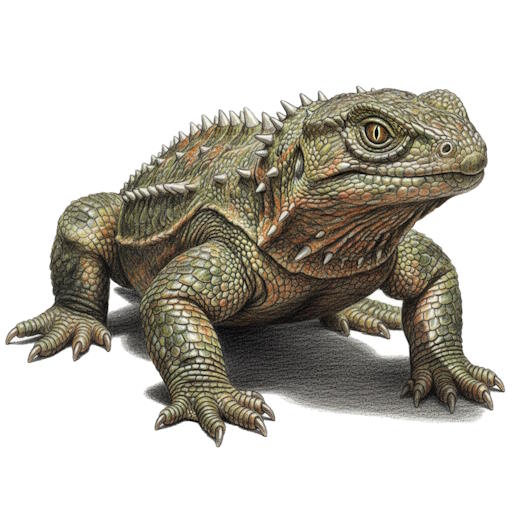
Tuatara
Classification
Reptilia > Rhynchocephalia > Sphenodontidae > Sphenodon > S. punctatus
Native To
Conservation Status
Average Height
1 - 1.5 feet
(0.3 - 0.5 m)
Average Weight
1 - 2 lbs
(0.5 - 0.9 kg)
Average Life Span
60 - 100 years
Gestation Period
11 - 16 months
Did You Know?
The Tuatara is a reptile endemic to New Zealand and is the only surviving lineage of an order of reptiles that flourished 200 million years ago.
They have a "third eye" on the top of their head, called a parietal eye, which is sensitive to light and helps regulate their circadian rhythm.
Tuataras can live for over 100 years, making them one of the longest-living vertebrates.
They are nocturnal and thrive in cooler temperatures, preferring temperatures between 16-21°C (60-70°F).
The sex of a Tuatara is determined by the temperature of the nest; warmer temperatures produce males, and cooler temperatures produce females.
Tuataras are excellent burrowers and often share their burrows with seabirds.
Photo Gallery
No images provided yet. Be the first to upload one!