Mute Swan
The Mute Swan (Cygnus olor) is a large waterbird species found in Eurasia. It is known for its elegant, white plumage, its graceful posture, and its long, curved neck.
Despite its name, the Mute Swan is not mute. It has a variety of vocalizations, including hisses and snorts.
The Mute Swan is a social species, often found in pairs or small family groups. It is a common sight on lakes, ponds, and rivers, where it is often a symbol of beauty and grace.
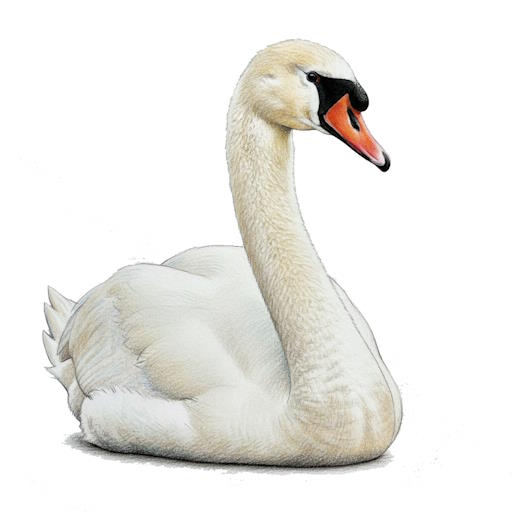
Mute Swan
Classification
Aves > Anseriformes > Anatidae > Cygnus > C. olor
Native To
Conservation Status
Average Height
4 - 5 feet
(1.2 - 1.5 m)
Average Weight
20 - 30 lbs
(9 - 14 kg)
Average Life Span
10 - 20 years
Gestation Period
35 - 38 days
Did You Know?
The Mute Swan is a large water bird native to much of Eurasia, and a common introduced species in North America.
They are known for their graceful S-shaped neck and beautiful white plumage.
Despite their name, Mute Swans are not truly mute; they make a variety of hissing, grunting, and snorting sounds, especially when threatened. Their name comes from being less vocal than other swan species.
Mute Swans build large nests of reeds and other vegetation, often on small islands or secluded spots near water.
The large black knob at the base of the bill, called a "knob" or "berry," is more prominent in males (cobs) than in females (pens).
A group of swans is sometimes called a "bevy" or a "wedge" when in flight.
Photo Gallery
No images provided yet. Be the first to upload one!